-
Rigging Viral Video Success at YouTube
While most of the world was de-stuffing itself from Thanksgiving over the last few days, a firestorm was raging at TechCrunch, a popular blog, over a guest post that described how you can rig YouTube to drive viral video success. The post was written by Dan Ackerman Greenberg (don't know him) who is co-founder of The Commotion Group and a graduate student at Stanford. His original post is here and his follow-up post is here.
The original post in particular is well worth reading. While it's easy to focus on the author's integrity (and many of the comments following the post do so), the most interesting takeaway for me is how YouTube, and broadband in general, is still a "wild west" environment, where popularity isn't always what it seems and knowing how to play the game can be a key to success.

Greenberg runs through a litany of "strategies" which his firm has used (or not used depending on how you read his follow on post) successfully to drive his clients' videos to huge success. These include using catchy titles, manufacturing dialogue around the video using fake identities, embedding videos in others MySpace pages, optimizing thumbnail descriptions, emailing the clips to everyone possible, manipulating tags, etc.
Of course there are no laws against any of this stuff, in my view it's an extension of guerilla marketing techniques seen elsewhere. It's using the full range of tactics available to achieve a client's goals and a stark reminder that consumers must always have their BS antenna up.
But whether you think it's unseemly or just an extension of guerilla practices long established in the offline world is beside the point. It's easy to tisk-tisk others for their business practices. But the reality is that if viral video success is important to you then you'd better be well-versed in the rules of the game and be prepared to play it like the winners do.
Categories: Video Sharing
Topics: YouTube
-
A Thanksgiving Thank You to VideoNuze's Sponsors
In the spirit of the season, I'd like to offer a huge THANKS to VideoNuze's outstanding sponsors. Below they are listed along with their own descriptions:
Akamai - Akamai is the leading global service provider for accelerating content and applications online. click here for more
ExtendMedia - ExtendMedia provides software and media services that enable content providers and distributors to quickly and securely create, deliver, manage and monetize online content offerings over many devices. click here for more
thePlatform - thePlatform, a subsidiary of Comcast, is the leading broadband video ASP for content providers, broadband media sites, and mobile businesses. click here for more
Voxant - Voxant is building a new kind of network that delivers unparalleled licensed content, advertising and services to millions of web sites and niche communities throughout the Web. click here for more
Atlas Venture - Atlas Venture is an international early-stage venture capital firm that invests in communications, information technology and life sciences companies. click here for more
Brightcove - Brightcove is an Internet TV service that empowers video producers and programmers to build broadband businesses while giving viewers more choices and control over their use of video and television. click here for more
Digitalsmiths - Digitalsmiths is the company behind VideoSense, the first universally compatible and future-proof broadband video contextual ad-matching system. click here for more
ICTV - ICTV provides the technology and distribution network that enables television programmers and Web publishers to deliver broadband video and other media to television in an engaging, immersive TV-quality viewing experience. click here for more
PermissionTV - PermissionTV offers a flexible platform for delivering innovative and interactive video experiences on the Web. PermissionTV tools empower companies to use video to capture new audience, enhance relationships and maximize customer value. click here for more
Please take a moment to check them out!
Categories: Miscellaneous
-
Warner Bros. International Television's On-Demand Rollout Seems On Track
A piece in Variety yesterday describing WBITD's aggressive new strategy to mine on-demand opportunities in cable, satellite and broadband underscores how technology is driving new distribution options and revenue opportunities, while at the same time posing new challenges to traditional business models.

The article, entitled "WB Shows Go On-Demand" outlines how WBITD is launching "Warner TV" branded on-demand initiatives in Europe and Asia. That Warner will be offering its library of films and TV programs Warner entirely on-demand is a clear acknowledgement that consumer behavior has shifted beyond the "appointment viewing" paradigm of linear TV.
This shift, along with scarce channel capacity and resistant service providers, have all contributed to the fact that launching new cable networks here in the U.S has all but dried up. The recently unveiled Fox Business Channel is a huge exception; behind the scenes there are scores of people who aspired to launch their own cable networks who have now shifted their focus to on-demand, or increasingly to broadband.
Jeffrey Schlesinger, WBITD's president put his finger on why the on-demand and broadband models make so much sense, "The costs here are much lower than creating a linear channel. You don't have as much on-air promotion that you have to do. You don't have as much scheduling or advertising sales infrastructure. You don't have to worry about commercial insertion."
Building a new programming franchise today is more about nimbleness and experimentation than big structure and deliberative scheduling. WBITD seems to recognize this and also seems to be willing to test lots of different models depending on the opportunities and circumstances it encounters in each local market.
Of course the key balancing act for WBITD here is pursuing these new initiatives without disrupting existing revenue streams and relationships. That's the first thing I hear from all content providers who have a vested interest in existing models, but a hunger for new revenues. WBITD is sensitive to this: its plan is to offer library titles or a secondary window on current programming,
Add WBITD to your "watch list" of companies pioneering how distribution will work in the broadband era.
Categories: International
Topics: Warner Bros.
-
Adap.tv Improves Broadband Video Ad Targeting with CPC Approach
As the broadband video world continues to coalesce around advertising as its primary business model, there is a flurry of companies seeking to improve the monetization process. As I've written before, this is critical work, because at some point the bloom will be off the broadband video rose if participants can't earn an attractive ROI.
Enter Adap.tv, which is addressing the ad monetization challenge. The company was founded last year and is based in San Mateo, CA. It is backed by Redpoint and Gemini and now has 20 employees.

CEO/co-founder Amir Ashkenazi recently gave me a run-down on Adap.tv's approach and progress. Amir was the founder of Shopping.com, which was acquired by eBay and he has brought together many former colleagues for his experienced management team.
Like its competitors, the heart of Adap.tv's model is its ad targeting and relevance engine. Adap.tv uses a "multi-disciplinary approach": analysis of the video/audio (context, metadata, etc.), analysis of the ad (keyword submission, etc.) and analysis of the user (demographics, location, etc.). This data is then fed to a matching engine to pair ads with the most relevant video. Over time the system optimizes based on actual click behavior.
Adap.tv is highly focused on overlays (Amir believes this will be the "de-facto standard" soon), and provides a series of customizable templates for advertisers (see below Kayak overlay). It is also positioning itself as a cost-per-click model, so there's no fixed cost to advertisers. In fact, advertisers can power Adap.tv ads using the same keyword feeds they use for their keyword campaigns.

So far publishers have been responsive to the CPC model because they see overlays as opening up a lot of untapped inventory. Obviously implementing overlays needs to be done judiciously or the viewer experience will become cluttered and broken. Amir believes the whole broadband video ad model will move to CPC over time as advertisers become more sophisticated and focused on performance. This Google-like model would be very good news for advertisers, but would be a brave new world for traditional broadcast and cable networks long accustomed to CPM approaches in their traditional businesses.
While I think a more performance-based broadband ad environment would be welcome, I continue to believe a CPC/overlay approaches will ultimately co-exist with CPM/pre-rolls. There's a lot of interest in overlays, yet there are too many great 15 and 30 second TV spots not be re-used online and the CPMs are way too rich for big branded content providers to walk away from.
Other companies that are in the contextual analysis and/or overlay space include: ScanScout, Digitalsmiths (note: a VideoNuze sponsor), YuMe, blinkx, VideoEgg, YouTube, Brightcove, AdBrite, Viddler (which TechCrunch just wrote about yesterday) and others I'm sure I'm missing or are yet to surface.
Categories: Advertising, Startups, Technology
Topics: Adap.TV, AdBrite, Blinkx, Brightcove, Digitalsmiths, ScanScout, Viddler, VideoEgg, YouTube, YuMe
-
TV and Broadband: Who's Morphing into Whom?
Does TV programming beget broadband video programming or is it the other way around?
If you were expecting a simple answer, recent evidence suggests that none will be forthcoming. Step away from the relatively straightforward model of streamed or downloaded TV episodes, and the question of how original video content will be produced and distributed between broadband and TV is whole lot more complicated. Layer on the writers' strike and the world only fogs up further.
For those who see broadband as a pathway to TV, Quarterlife's deal announced last Friday with NBC to bring their new Quarterlife series to the network following its run on MySpace offers encouragement that Internet programming can move to the TV (bear in mind that Quarterlife was originally pitched as a TV series however).
Another example is TMZ.com, which has been successfully syndicated as TMZ TV this fall by Warner Bros. TMZ shows us that a brand that was created and built solely online can make the leap to TV. And just last week TV Week reported that Twentieth Television and Yahoo were close to a deal to create a new syndicated series based on popular broadband videos that they've collected.
On the flip side, there is plenty of evidence of opportunities for TV programs spinning off broadband programming, or existing TV producers with assets and skills pushing into broadband as a first outlet for their work.
Consider Sony's Minisode Network, with distribution on MySpace, Joost, AOL and Crackle. In an effort to squeeze more life out of its library of classics, in June Sony launched abbreviated versions, for broadband "snacking". This initiative is being closely watched as a model for how to repurpose existing assets to make them more palatable for attention-challenged online audiences.
And Endemol's recent deal with Bebo to produce "The Gap Year" series for exclusively for Bebo's audience shows that a successful TV producer is turning its sites on broadband as a first outlet.
All of these deals underscore broadband's disruptive nature - its ability to create new opportunities for incumbent players, and also for new entrants. My read is that most (though not all) broadband producers would love to make the leap to the TV. In the mean time, broadband offers a low-cost, interactive distribution path to experiment with more engaged audiences.
Many key industry players are now waking up to the idea that broadband is fundamentally re-writing traditional equations of how to extract value from well-produced video. But these equations are not yet well-understood. Some of the early deals, as outlined above, will be showing everyone the way.
Categories: Broadcasters, Indie Video, Partnerships, Video Sharing
Topics: AOL, Bebo, Crackle, Endemol, Joost, MySpace, NBC, Quarterlife, Sony, TMZ, Twentieth Television, Warner Bros, Yahoo
-
MySpace-VIBE-KickApps Deal May be a Harbinger of What's to Come
Traditional relationships between content providers and powerful aggregators/distributors are being fundamentally challenged broadband video. That's because broadband is an open medium, allowing content providers and brands to enjoy unprecedented direct access to their target audiences. This diminishes a lot of the leverage that aggregators/distributors have traditionally had.
Yet, as I have said for a while, I believe that there's a place for direct-to-consumer and third party distribution/promotion to co-exist harmoniously. But finding good examples has been a challenge. That's why a deal that KickApps announced today with MySpace and VIBE for its "Vibe Verses 3" promotion resonated strongly for me.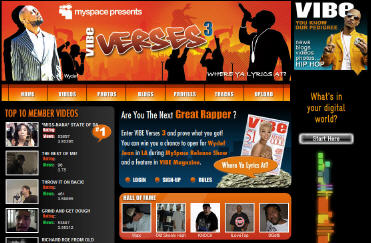
In a nutshell here's how the deal works: a major social networking site (MySpace) has partnered with a specialty publisher (VIBE) for a user generated video-dominated contest (VIBE Verses 3) to build a long term user-generated franchise (powered by KickApps), which will be mainly supported by ad sales.
To understand the deal better, I talked to Michael Chin, SVP of Marketing at KickApps earlier this week. For those not aware, VIBE is a major brand for the urban scene and VIBE Verses 3 is the third round of a contest that "challenges aspiring rap artists to upload videos of themselves performing original lyrics over pre-selected music tracks." Basically you can think of it as an "online-only, urban American Idol." All of the video uploads and social networking is powered by KickApps.
What's interesting to me is that MySpace is involved as the main promotional partner, seeking to build out its strength in this key category. As a large general purpose community site, they're partnering with VIBE, a well-known brand in the category, to bring more value to their members. As Josh Brooks at MySpace puts in the release, "VIBE is a pillar in hip hop and this partnership will help solidify MySpace as the place online for established and developing hip hop artists."
And according to Michael, this was done as a biz dev deal, not an ad sales deal. MySpace and VIBE believe that together they can build a franchise in hip hop that generates longer term value by creating a large, engaged audience of interest to other brands (e.g. Coke, Nike, etc.).
Of course none of this would be possible without broadband - it's the enabler for the user-generated videos that are at the heart of the contest.
In the open broadband video era where direct access to the consumer is ubiquitous, it's going to take more creativity to make deals work for everyone. I think this one is a good example of what can succeed. The deal serves as a template for how other specialty content providers and aggregators/distributors might work together, tapping user participation to build franchises that leverage each party's core skills and assets.
Categories: Aggregators, Brand Marketing, Partnerships, UGC
Topics: KickApps, MySpace, VIBE, VIBE Verses
-
Red Lasso: Exclusive First Look

Red Lasso is a stealthy company that's been around for about 2 years, though only now coming up to the surface. I did a phone briefing earlier this week with Kevin O'Kane, President/founder and Al McGowan, COO. They also gave me access to the private beta and I've been playing around with it for the last couple of days.
Red Lasso's goal is "to help broadcasters extend the life of their content, legitimately." They're positioning themselves as "an anti-YouTube", allowing broadcasters to proactively contribute long form video and audio, which users can then search and clip for exactly the content they're looking for. The video can simply be watched or it can be embedded. Though they don't want to be seen as an "online DVR", it is tempting to see them as such. Monetization is most likely through advertising, though a licensing model is possible as well.
Red Lasso's playing in the same basic space as Voxant (note: a VideoNuze sponsor) and Clip Syndicate (see this for more), with a key differentiator being the long form content availability and clipping feature. Red Lasso is currently taking 150 different broadcast feeds from around the country, and their ability to get the industry to cooperate is helped by the fact that Al and Kevin are broadcast veterans.
Red Lasso is trying to appeal to at least 3 types of users: broadcasters seeking to flexibly publish specific video clips on their own sites, independent web sites trying to feature key segments of their own video (e.g. sports teams) and bloggers seeking to embed video. They believe this third group is the most fertile territory and I agree.
Bloggers across the spectrum (politics, entertainment, sports, etc.) have been hungry for video clips to enhance their sites. I believe this demand will only increase. If you're a blogger looking just for the "money quote", clipping from long form assets provides a lot of value. I did some searching and clipping (below is one result).
I found the clipping pretty straightforward, and I liked the fact that I could save mine, which I can also publish to the community for widespread viral use if I choose to. The searching is based on phonetic and closed caption text. It was not quite as accurate as I hoped, but video search is a very tough nut to crack, and so I'd expect room for improvement there.
At a strategic level, Red Lasso again demonstrates how broadband's influence is going to be felt in the broadcast TV industry. I think traditional concepts of appointment viewing, geographic constraints and local ad sales are all going to seem quaint as broadband allows quality video to fly around the net. I'd urge broadcasters to be looking closely at all the players in this space.
Red Lasso has a staff of about 20 and is based in King of Prussia, PA. It has raised $6.5M from investors including Pat Croce (former head of Philadelphia 76ers), Anthem Capital, Osage Ventures and the Guggenheim Opportunity Fund.Categories: Broadcasters, Technology, Video Sharing
Topics: Anthem Capital, Clip Syndicate, Guggenheim Opportunity Fund, Osage Ventures, Pat Croce, Red Lasso, Voxant
-
Movielink-Target Download Promotion Makes No Sense to Me
Yesterday I received the below email from Movielink promoting a "Steal of a Deal" offer with Target. Here's how it works: I purchase an Ocean's Thirteen DVD at a Target store and I receive a code that then entitles me to download Ocean's Thirteen from Movielink.
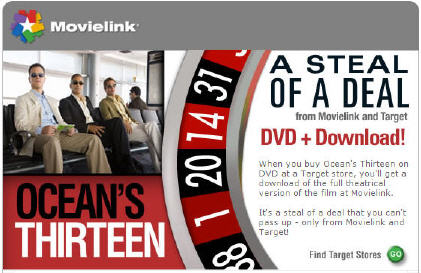
Maybe I'm missing something (and please let me know if I am), but this promotion makes no sense to me and instead seems to possibly undermine the value of the Movielink service.
As with all marketing and promotional efforts, the starting point must always be "What's our objective?" So what is Movielink's objective here?
To expose people to the Movielink brand and service? That wouldn't make sense since I only received the email because I was on their email list in the first place.
To demonstrate there's consumer appetite for downloading the same that was just bought on DVD? That seems like a silly and sort of pointless thing to prove in the first place if you believe the ultimate opportunity for digital downloads is to be a DVD substitute, not a compliment.
To expose people to the breadth of Movielink's service? That's worthy, but the offer is limited to downloading the same title that was purchased, so the user isn't incented to browse and see the full breadth of the Movielink catalog.
Maybe there's another objective, but if so I don't see it. Instead I think the campaign ends up detracting from Movielink by confusing the user and not creating any really new distinctive value. Think about it - if you're a consumer that just bought the Ocean's Thirteen DVD, what new value is the download providing you? (Let me know if you can think of anything, I can't)
Movielink could have enhanced this campaign to greater effect in lots of different ways. Ideas: Open the download choice to anything in the catalog. Or make the download easily giftable to a friend to virally increase Movielink's awareness. Or create a rewards-style program that gives DVD purchasers credits toward subsequent downloads. And so on.
I'm not trying to pick on Movielink's marketers, I see this kind of thing all the time. Murky objectives coupled with confusing/underwhelming offers. For broadband video to succeed - either in paid or ad-supported, marketers must be extremely thoughtful and precise about what they're trying to incent their target audiences to do, and how that specific action helps build the business.
Categories: Brand Marketing, Downloads, Partnerships
VideoNuze Posts

Connect with VideoNuze
Exclusive News Roundup
- Netflix Pushes Further Into Live Programming With ‘The Breakfast Club’ WSJ
- Roku builds dedicated creator content hub, expands FAST channels StreamTV Insider
- Amazon, Netflix and Google to Capture Half of CTV Ad Market by 2030 TV Tech
- YouTube's AI deepfake detection tool is now available to all creators 18 and older Engadget
- Paramount’s Warner Bros. Takeover Expected To Breach Its SkyShowtime Venture With Comcast Deadline
- Netflix Says Its Ad-Supported Tier Now Has 250 Million Monthly Viewers Cord Cutters News